
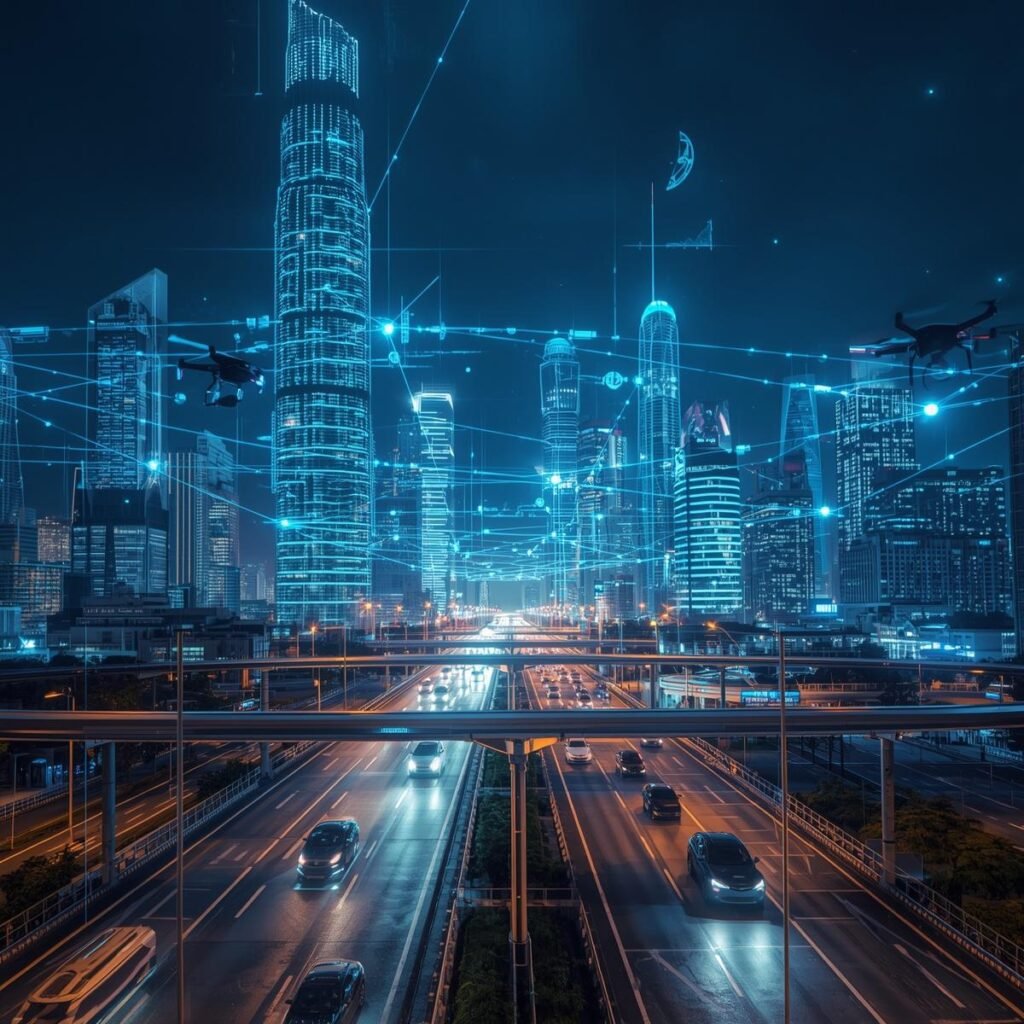

Artificial intelligence is reshaping how cities operate, plan infrastructure, deliver services, and respond to growth. Urban areas face rising population density, pressure on transport systems, demand for housing, energy consumption growth, waste management challenges, and climate impact concerns. AI provides data processing capability that allows governments to manage these systems through analysis, prediction, and automation.
Smart cities rely on connected sensors, communication networks, cloud platforms, and analytics engines. AI acts as the processing layer that transforms raw data into decisions. It does not replace urban planners or public officials. Instead, it supports them with insights derived from large-scale datasets.
This article explains how AI supports smart cities and urban development across transportation, infrastructure, governance, sustainability, public safety, and economic planning.
What Defines A Smart City
A smart city integrates digital infrastructure into physical infrastructure. This includes:
- Internet connected sensors
- Surveillance systems
- Traffic monitoring devices
- Energy grid monitoring tools
- Data centers
- Cloud computing services
Data collected from these systems flows into centralized or distributed processing platforms. AI analyzes patterns, identifies anomalies, and recommends actions.
Cities such as Singapore and Barcelona have implemented smart systems to manage traffic, water distribution, and public services.
AI In Traffic And Mobility Management
Urban traffic congestion results in fuel waste, lost productivity, and environmental impact. AI systems monitor traffic flow through:
- Road cameras
- GPS data
- Public transport tracking
- Sensor networks
Machine learning models predict congestion based on time, weather, and event data. Adaptive signal control systems adjust traffic lights in real time to improve flow.
Ride-sharing services and navigation platforms also rely on AI for route optimization. By analyzing live traffic data, these systems reduce travel time and fuel consumption.
Autonomous vehicle development further integrates AI into city mobility networks.
AI In Public Transportation Systems
Public transportation networks depend on scheduling accuracy and demand forecasting. AI processes passenger flow data collected from ticketing systems and mobile apps.
AI supports:
- Route optimization
- Fleet allocation
- Maintenance scheduling
- Passenger demand forecasting
Predictive maintenance reduces breakdowns by analyzing equipment sensor data. AI identifies early signs of mechanical failure, allowing maintenance teams to act before service disruption occurs.
AI In Energy Distribution And Smart Grids
Urban energy systems require coordination between power generation and consumption. AI models analyze energy usage patterns across residential, commercial, and industrial sectors.
Smart grids use AI to:
- Balance energy load
- Integrate renewable sources
- Detect grid faults
- Predict peak demand
Cloud providers such as Microsoft and Amazon Web Services offer AI-powered infrastructure solutions that support city-scale data processing.
AI improves energy efficiency and reduces system outages.
AI In Water And Waste Management
Water systems include supply networks, treatment facilities, and distribution pipelines. AI detects leakage through anomaly detection algorithms that monitor pressure and flow data.
In waste management, smart bins equipped with sensors transmit fill level information. AI analyzes collection routes and optimizes logistics.
Benefits include:
- Reduced fuel consumption
- Improved sanitation scheduling
- Lower operational cost
Data driven waste management supports environmental sustainability goals.
AI In Urban Planning And Development
Urban planning involves long-term forecasting. AI models simulate population growth, housing demand, and infrastructure needs.
Planners use digital twin technology to replicate city infrastructure in virtual models. AI analyzes how policy changes affect traffic, energy use, and housing development.
By running simulations, governments reduce risk before implementing large projects.
AI In Public Safety And Emergency Response
AI supports surveillance systems and emergency coordination.
Applications include:
- Video analytics for incident detection
- Crime pattern analysis
- Disaster risk modeling
- Emergency route planning
During natural disasters, AI systems analyze weather and infrastructure data to guide evacuation strategies.
Environmental Monitoring And Sustainability
Air quality, temperature levels, and pollution indicators are monitored through sensor networks. AI models track trends and identify risk zones.
Cities use AI to:
- Monitor carbon emissions
- Predict flood zones
- Manage green space planning
- Track noise levels
Data analysis informs sustainability policies.
Data Governance And Privacy Challenges
Smart cities collect vast amounts of citizen data. This raises privacy and cybersecurity concerns.
Key issues include:
- Data ownership
- Consent management
- Secure storage
- Ethical use of surveillance
Governments must implement strong data protection frameworks to maintain public trust.
Economic Impact Of AI In Urban Development
AI reduces operational inefficiencies across transport, utilities, and administrative services. Efficient systems lower municipal spending and improve service delivery.
Smart cities attract investment from technology firms and research institutions. Digital infrastructure supports startup ecosystems and job creation.
AI driven urban development contributes to long-term economic planning.
The Future Of AI In Smart Cities
Future smart city development may include:
- Autonomous public transit networks
- AI-managed infrastructure maintenance
- Integrated mobility platforms
- City-wide predictive analytics dashboards
AI will continue to support urban development as data collection systems expand.
SEO Keywords For Ranking
Primary keywords:
- AI in smart cities
- Role of AI in urban development
- Smart city technology AI
- AI infrastructure management
- Artificial intelligence urban planning
Secondary keywords:
- AI traffic management systems
- AI smart grid solutions
- Smart city sustainability technology
Structured headings and keyword placement improve indexing and search performance.
Conclusion
Artificial intelligence plays a central role in smart cities and urban development by transforming data into decisions. From traffic management and public transport to energy systems and environmental monitoring, AI enhances efficiency and planning accuracy.
Urban growth requires scalable and data-driven solutions. AI provides the computational capability to manage complex city systems while supporting long-term sustainability and economic growth.