
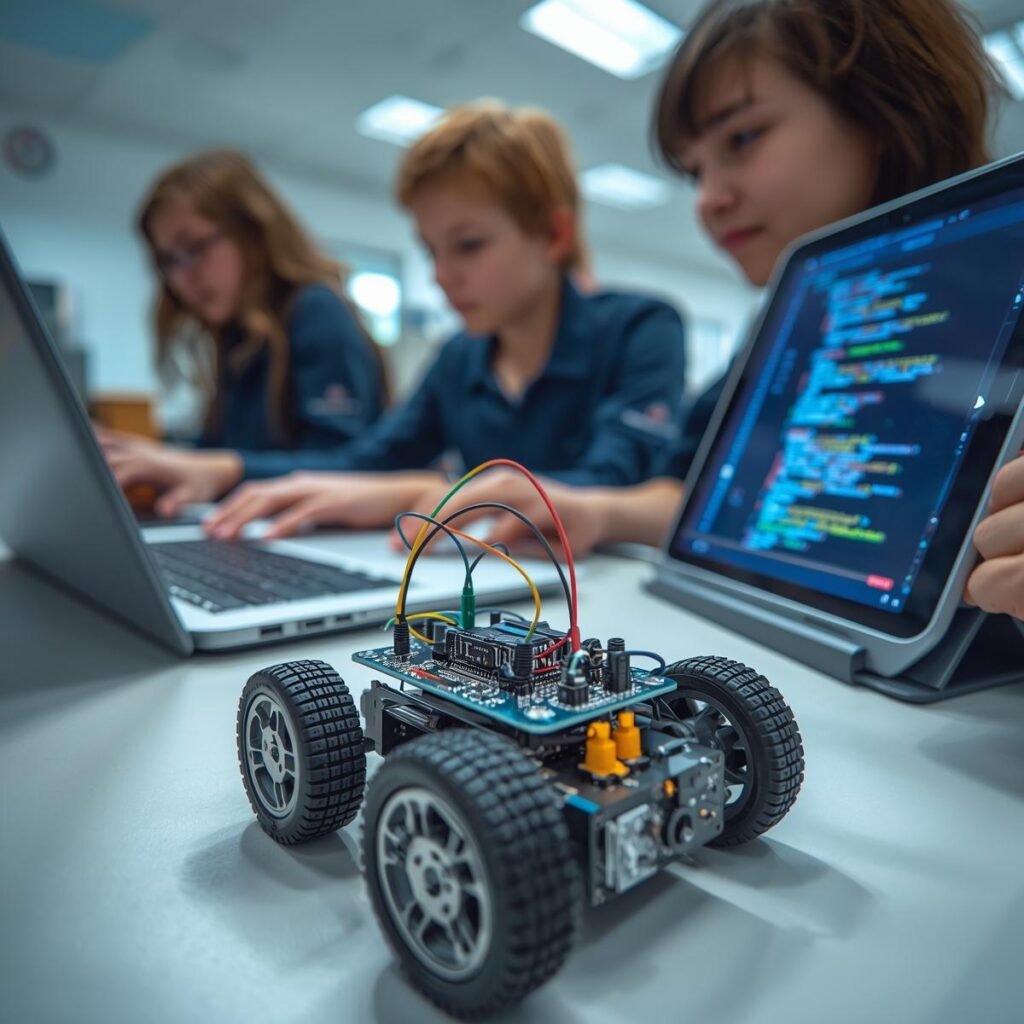

Educational robotics connects coding concepts with physical systems that students can build, program, and test. Instead of learning programming only through text on a screen, learners write code that controls motors, sensors, and processors inside robotic systems. This approach supports practical understanding of logic, automation, and problem solving.
Schools, training centers, and online academies now use robotics kits and programmable hardware to teach coding from early education through university level programs. Robotics platforms integrate software, electronics, and mechanical components into one learning environment.
What Is Educational Robotics
Educational robotics refers to the use of programmable machines to teach computational thinking and programming skills. These machines may include robotic kits, microcontrollers, programmable vehicles, robotic arms, or sensor-based systems.
Students write instructions that define how machines respond to input. For example:
- Move forward when a button is pressed
- Stop when a sensor detects an obstacle
- Follow a line on the floor
- Sort objects based on color detection
Each activity introduces core programming structures such as loops, conditions, and variables.
Why Robotics Improves Coding Education
Traditional coding education often relies on abstract examples. Robotics transforms abstract code into visible action.
Key benefits include:
- Direct feedback from physical systems
- Immediate demonstration of logic errors
- Increased engagement through hands-on work
- Integration of mathematics and engineering
When a robot fails to move as expected, students analyze the code and adjust logic. This debugging process strengthens understanding of algorithms.
Core Components Of A Robotics Learning System
Educational robotics systems typically include:
- Microcontroller or programmable board
- Sensors such as ultrasonic, infrared, or light sensors
- Actuators including motors or servos
- Power supply
- Programming interface
Popular educational platforms include:
- LEGO robotics kits
- Arduino boards
- Raspberry Pi devices
These tools allow students to write code using block-based or text-based languages.
Programming Concepts Taught Through Robotics
Robotics supports learning of foundational programming topics.
1. Variables
Students store sensor values in variables. For example, distance readings can be assigned to a variable for comparison.
2. Conditional Statements
Robots use if-else logic to respond to environmental input.
Example:
If distance < 10 cm
Stop motor
Else
Move forward
3. Loops
Loops control repeated actions such as continuous scanning.
4. Functions
Reusable blocks of code manage repeated tasks.
5. Algorithms
Students design step-by-step procedures to achieve goals like maze navigation.
Age Based Robotics Learning Path
Educational robotics adapts to different age groups.
Primary Level
- Block-based coding
- Simple movement commands
- Basic sensor interaction
Secondary Level
- Text-based programming
- Logic structures
- Robotics competitions
University Level
- Embedded systems
- AI integration
- Computer vision
- Autonomous navigation
This progression builds technical depth.
Robotics And STEM Education
Educational robotics integrates Science, Technology, Engineering, and Mathematics.
Students apply:
- Physics for motion control
- Mathematics for distance calculation
- Engineering for structural design
- Computer science for coding logic
This interdisciplinary approach builds analytical skills.
Robotics Competitions And Skill Development
Competitions encourage application of coding knowledge.
Events require teams to:
- Design robots
- Program task execution
- Solve timed challenges
- Present technical documentation
Participation strengthens teamwork and problem solving.
Robotics And Artificial Intelligence Learning
Modern robotics platforms support AI modules such as:
- Image recognition
- Object detection
- Voice command processing
Students can integrate machine learning libraries to create intelligent robotic behavior.
For example, a robot may classify objects using camera input and trained datasets.
Tools And Software For Robotics Programming
Educational robotics platforms support multiple programming environments.
Common languages include:
- Python
- C++
- Scratch
- Java
Integrated development environments provide code editors and simulation tools.
Simulation allows testing without hardware damage.
Real World Applications Of Robotics Education
Skills gained through robotics apply to industries including:
- Automation
- Manufacturing
- Healthcare devices
- Logistics
- Smart home systems
Understanding embedded programming prepares students for careers in AI and robotics engineering.
Challenges In Educational Robotics
Despite benefits, challenges include:
- Hardware cost
- Maintenance requirements
- Teacher training
- Curriculum integration
Schools must invest in instructor development to maximize learning outcomes.
Online Learning And Robotics
Online platforms now offer virtual robotics labs.
Students use simulators to:
- Write code
- Test robot behavior
- Analyze sensor data
Remote education expands access to robotics training.
Future Of Educational Robotics
Future developments may include:
- Cloud connected robots
- AI integrated curriculum
- Edge computing modules
- Real time collaborative coding
As automation expands across industries, robotics education will become part of standard digital literacy programs.
SEO Keywords For Ranking
Primary keywords:
- Educational robotics
- Teaching coding with robots
- Robotics for students
- Learn programming through robotics
- STEM robotics education
Secondary keywords:
- Robotics coding curriculum
- AI robotics learning
- Arduino robotics education
- Raspberry Pi coding projects
Structured headings improve search indexing.
Conclusion
Educational robotics bridges the gap between theory and practical coding application. By programming smart machines, students gain experience with algorithms, debugging, and system design. Robotics education supports STEM learning and prepares learners for careers in automation and artificial intelligence.